A future where broken bones could be healed with precision, not plates
Imagine breaking your ankle four times.
Well, I don’t have to imagine it — I actually did. Between the endless doctor visits, the pain, and the frustration of waiting for bones to heal, I learned firsthand how exhausting recovery can really be. The cast itches, crutches hurt, and the x-rays seem to take forever to show progress. Each time, I wondered: Isn’t there a better way to fix something that is so common?
Turns out, there might be…
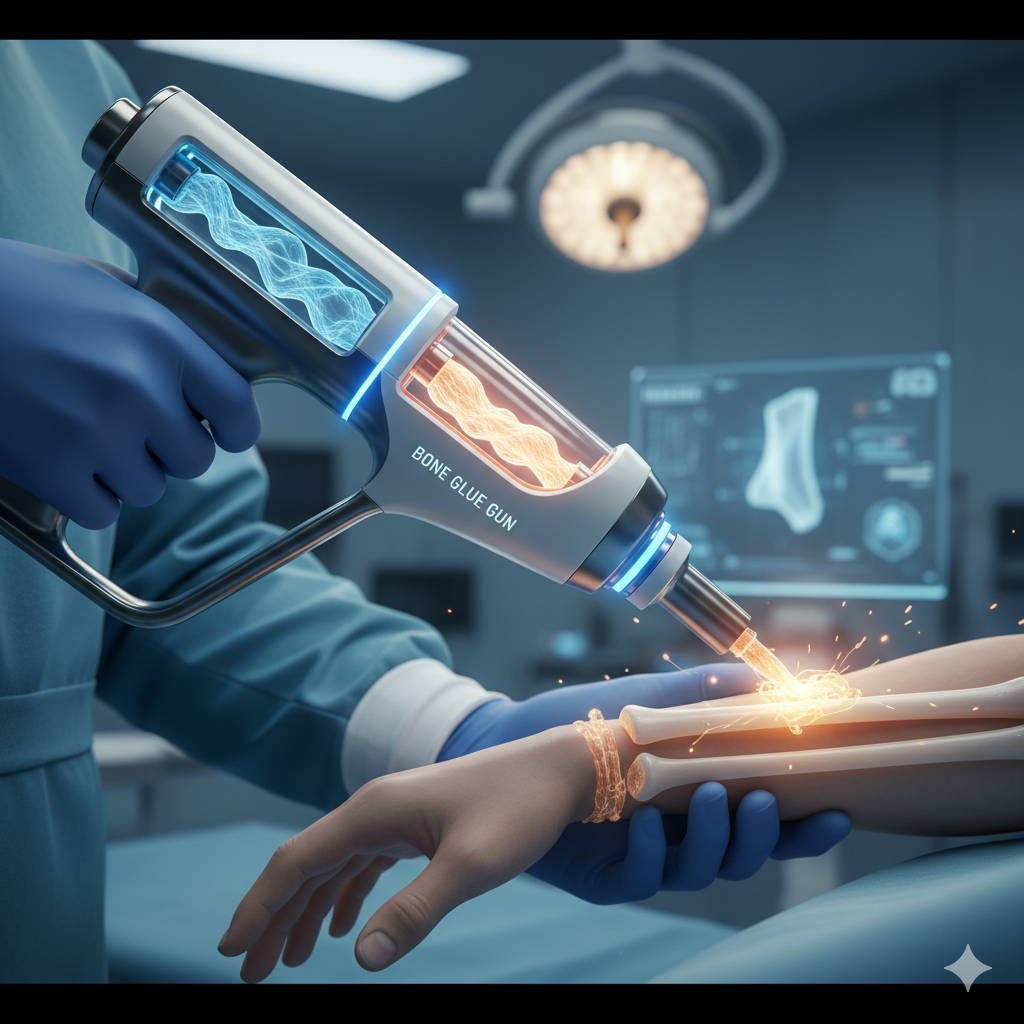
Scientists are developing what’s being called a “bone glue gun” — a handheld device that can literally seal fractured bones using a special regenerative adhesive. And yes, it’s exactly as futuristic (and incredible) as it sounds.
For decades, the go-to solution for serious fractures has always been metal plates, screws, or surgical pins. They hold bones in place, but they also come with pain, risk, and limitations. Some people need extra surgeries just to remove the hardware; others deal with lingering stiffness or nerve damage.
The new bone glue gun aims to change that completely. In South Korea at Sungkyunkwan University, the handheld device was developed to extrude a bone-like filament made from polycaprolactone (PCL) and hydroxyapatite (HA)—and it can be loaded with antibiotics for local delivery.
When heated and applied to a fracture, this mixture behaves like a biological glue — filling gaps, fusing fragments, and hardening within minutes. Once cooled, it forms a stable scaffold that holds the bone perfectly in place. Over the next few weeks, it slowly dissolves as new bone tissue grows in, leaving behind nothing artificial — just bone. Practically, it lets surgeons “weld” bones together while letting the body take over the rest.
This innovation could completely transform the journey of having orthopedic surgery:
- Faster healing: The glue acts as a framework for cells to regenerate bone tissue right away at a much faster rate.
- Less pain, fewer surgeries: No screws or metal rods means for fewer follow-ups and faster mobility.
- Better for kids and elderly patients: It adapts to the body’s natural growth and bone density.
- Portable and quick
Many poeple who have gone through the process of having orthopedic surgery know the routine of casts, boots, and recovery rooms — and that this transformation is huge. A simple procedure could replace months of waiting, helping patients get back on their feet both literally and mentally.
The Science Behind the Glue
At its core, the glue gun is built on biomimicry — designing materials that imitate how a real bone works and functions. Natural, real bone is a mix of both collagen fibers as well as minerals that make it strong yet flexible. The glue mimics that balance by combining soft, elastic polymers with rigid mineral nanoparticles.
When heated, the glue flows smoothly between bone fragments. When it cools, it hardens — creating stability and allowing the body’s own healing process to begin. Some researchers are even exploring adding stem cells or growth factors into the glue, turning it into an active healing agent rather than a passive patch.
It’s not just fixing bones — it’s guiding the body to repair itself.
One of the most promising uses for the bone glue gun is in emergency and trauma medicine. On a battlefield or even at the site of a car crash, doctors don’t have time or equipment for complex bone surgery, so a portable glue gun could instantly stabilize a broken limb, preventing further damage until proper treatment is available.
In hospitals, it could revolutionize pediatric and geriatric care — two groups most vulnerable to fractures. Instead of inserting rigid implants, doctors could apply the glue through a minimally invasive procedure and let the bone regenerate naturally.
Of course, this innovation still has challenges. Researchers are testing how well the glue performs under stress, how long it takes to fully degrade, and whether it bonds safely in different parts of the body. They’re also working on temperature control to ensure the glue sets perfectly without harming nearby tissue.
But early results are promising. In lab studies and animal trials, bones treated with the glue gun showed strong healing and faster recovery compared to traditional methods.
This isn’t just about a clever medical device. It’s part of a broader shift toward bioresponsive medicine — where materials don’t just support the body; they collaborate with it. The same principles behind the bone glue gun could one day lead to self-healing tissues, smart sutures, or implants that disappear after recovery.
When I think back to my own injuries, I can’t help but imagine how different recovery could be in a world with technology like this. No metal, no endless casts — just a quick, natural fix. The idea that a glue gun could someday repair a broken bone feels almost poetic: simple, precise, and full of hope.
Science isn’t just healing faster — it’s healing smarter.
Subscribe to our newsletter!