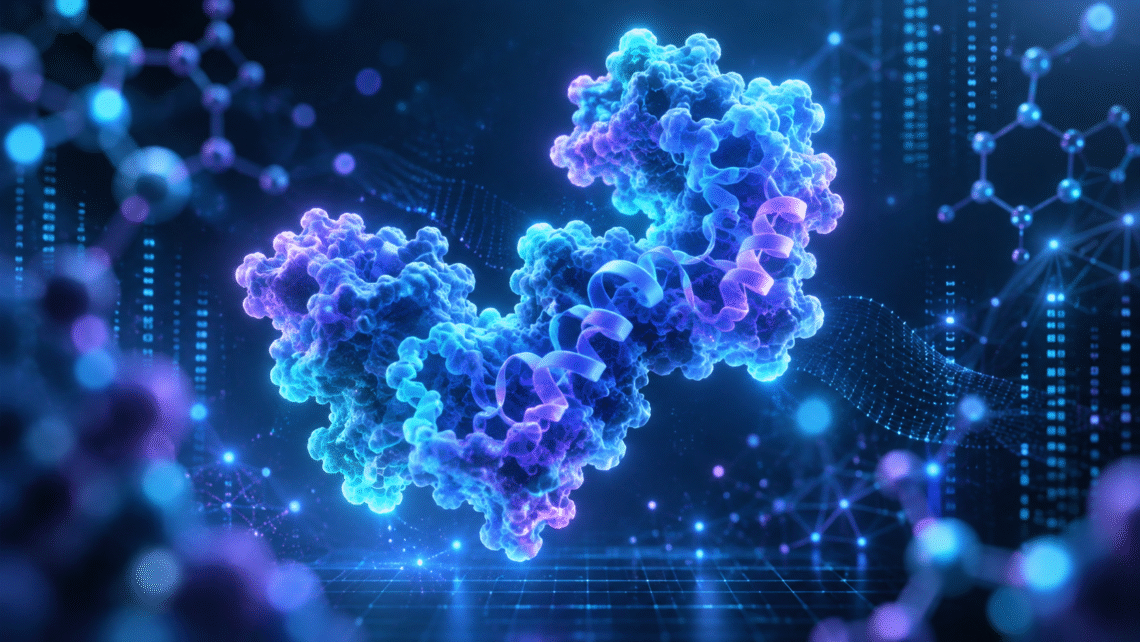
When most people think about medicine, they probably think about pills, shots, or maybe a doctor prescribing a treatment after looking at test results.But what if the next medicine is not just discovered in nature or made by trial and error?What if it is designed by AI?That is the idea behind AI-designed proteins.Proteins are basically tiny machines inside the body. They help cells communicate, fight infections, build tissues, speed up reactions, and control a lot of what happens in living systems. Almost everything in biology depends on proteins in some way.So if scientists could design new proteins on purpose, that would be a huge deal.The interesting part is that proteins are made from sequences of amino acids. Those sequences decide how the protein folds, what shape it takes, and what job it can do. A small change in a protein’s sequence can completely change how it behaves.That is why protein design is so hard.It is not enough to just make a random sequence and hope it works. The protein has to fold correctly. It has to be stable. It has to interact with the right target. It has to avoid causing problems in the body. And if it is being used as a medicine, it has to be safe.For a long time, scientists mostly had to rely on natural proteins or slowly modify existing ones. They could test different versions in the lab, see what worked, and keep improving them. That process still matters a lot, but it can take a long time.AI changes the question.Instead of only asking, “What proteins already exist?” scientists can start asking, “What protein should exist?”That sounds dramatic, but it is basically what generative AI is trying to do in biology.The same way AI can generate text, images, or music by learning patterns, AI models can also learn patterns in biological data. They can study protein sequences and structures, then help suggest new designs that may have a specific function.For example, scientists might want a protein that binds to a disease-related molecule. Or a protein that helps trigger an immune response. Or an enzyme that breaks down a harmful chemical. Instead of searching endlessly through nature, AI could help design a protein that is built for that purpose.That is what makes this field feel so futuristic.AI is not just reading biology anymore. It is starting to help write it.One of the biggest uses could be medicine. Many drugs work by interacting with proteins in the body. Some medicines are proteins themselves, like antibodies or certain hormones. If AI can help design better proteins, it could help create new treatments for diseases that are hard to target right now.Cancer is one example. Tumors can be difficult because cancer cells change, hide from the immune system, and sometimes become resistant to treatment. AI-designed proteins could possibly help create more targeted therapies that recognize cancer cells more precisely.Vaccines are another possibility. A vaccine has to show the immune system what to recognize. If AI can help design protein structures that train the immune system better, vaccines could become faster to develop or more effective.There are also enzymes.Enzymes are proteins that speed up chemical reactions. The body uses them constantly, but enzymes can also be used outside the body. Scientists can use them in medicine, manufacturing, environmental cleanup, and even sustainability. If AI can design enzymes with new abilities, biology could become a tool for solving problems in completely new ways.That part is honestly one of the coolest things about protein design.It is not only about treating disease. It is about building biological tools.A designed protein could help detect disease earlier. Another could deliver a drug to the right place. Another could break down waste. Another could become part of a new therapy that does not exist yet.But this does not mean AI just presses a button and creates a perfect medicine.That is the part people sometimes misunderstand.AI can suggest designs, but scientists still have to test them. A protein that looks good on a computer might not work in a real cell. It might fold differently than expected. It might be unstable. It might not bind to the right target. It might cause side effects.Biology is messy like that.A computer model can predict a lot, but the real world still gets the final vote.This is why lab testing is still extremely important. AI can narrow down the possibilities and help scientists move faster, but experiments are what prove whether the design actually works.There is also the safety side.If we can design new proteins, we have to be careful about what we are designing. Proteins can affect living systems in powerful ways. A helpful protein could become a medicine, but a poorly designed one could cause harm. That means scientists need strong testing, safety rules, and ethical boundaries.There is also the question of access.If AI-designed medicines become possible, will they be available to everyone? Or only to people who can afford expensive new therapies? This matters because new medical technology can be amazing, but it can also make healthcare inequality worse if it is not shared fairly.Still, the potential is huge.For most of history, biology has been something humans tried to understand. We observed it, studied it, and slowly learned how it worked. But now, we are entering a time where scientists may be able to design new parts of biology from scratch.That is a big shift.AI-designed proteins could change how we think about medicine, vaccines, enzymes, and biotechnology. Instead of waiting to find the right molecule in nature, researchers may be able to design one for a specific problem.The future of medicine may not only be about discovering treatments.It may be about building them.And maybe one day, the next breakthrough drug will not come from a plant, a chemical library, or pure luck.
It might come from an algorithm that learned how life’s tiny machines work — and then helped design a new one.