When we think about the human body, we usually think about organs.
The heart pumps blood. The lungs help us breathe. The brain controls thoughts and movement. The immune system fights disease.
But if you zoom in enough, the body becomes something else.
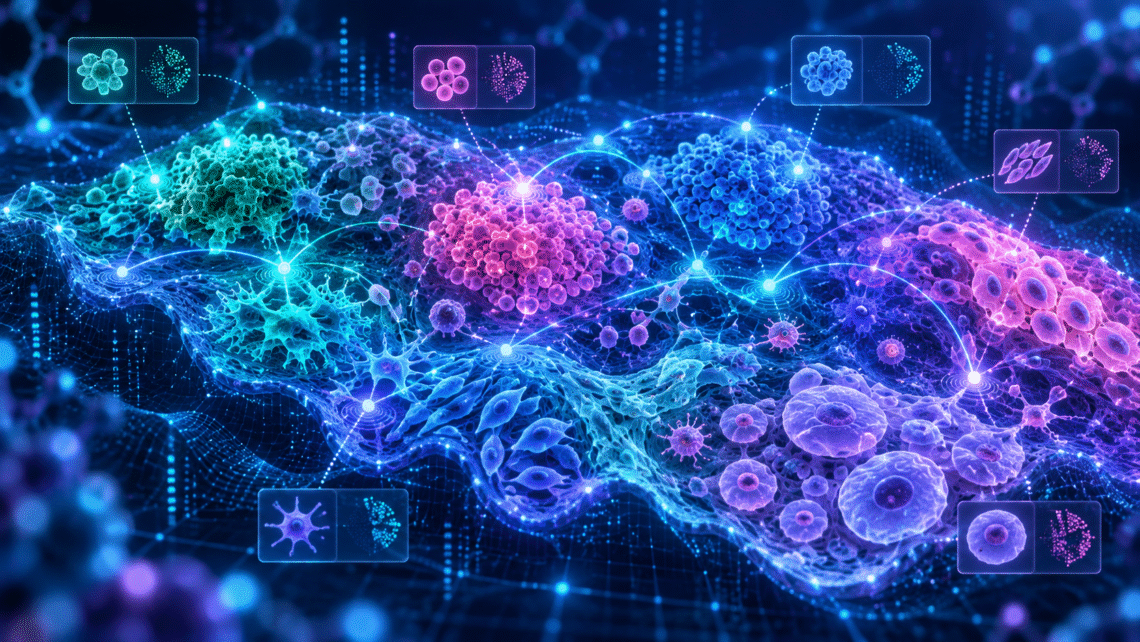
It becomes a map.
Not a map of roads or cities, but a map of cells. Billions of cells, each with their own job, location, signals, and neighbors. And just like location matters in a city, location also matters in biology.
That is where spatial biology comes in.
Spatial biology is the study of where cells and molecules are located inside tissues. It does not just ask, “What cells are here?” It asks, “Where are they? What are they doing? Who are they talking to? And how does their location change the way disease works?”
That might sound like a small detail, but it is actually a huge shift.
For a long time, scientists could study cells in powerful ways, but they often had to remove them from their original tissue first. It is kind of like taking all the people out of a city, mixing them together, and then trying to understand how the city works.
You might learn who lives there, but you lose the layout.
You lose the neighborhoods.
You lose who is next to who.
In the body, that layout matters a lot.
A cancer cell surrounded by immune cells might behave differently than a cancer cell surrounded by supportive tissue. A brain cell in one region can have a very different role from a similar-looking cell somewhere else. Even healthy tissue depends on cells being organized in the right places.
So spatial biology gives scientists something they were missing: context.
Instead of studying cells like a random list, researchers can study them like a map.
One way to think about it is Google Maps for the body.
Google Maps does not just tell you that there are restaurants, houses, roads, and schools in a city. It shows where they are, how they connect, and what is nearby. Spatial biology tries to do something similar with cells.
It can show where immune cells are located inside a tumor.
It can show which genes are active in different parts of tissue.
It can show how cells are arranged around blood vessels.
It can show which regions of tissue look healthy and which look diseased.
That is why this field is becoming so important in cancer research.
Tumors are not just clumps of bad cells. They are more like messy ecosystems. There are cancer cells, immune cells, blood vessels, connective tissue, and signals constantly moving between them. Some immune cells may be trying to attack the tumor, while other cells may be helping the tumor hide or grow.
If scientists only look at the average of all the cells in a tumor, they might miss what is actually happening in specific regions.
Spatial biology can help reveal those hidden patterns.
For example, a tumor might have one area where immune cells are close enough to attack cancer cells, and another area where immune cells are blocked out. That difference could help explain why some treatments work for one patient but not another.
This matters especially for immunotherapy.
Immunotherapy is a type of cancer treatment that helps the immune system fight cancer. But it does not work for everyone. One reason may be that the immune system is not just about which cells exist — it is also about where those cells are.
If immune cells are stuck outside the tumor, the treatment might not work the same way. If immune cells are already inside the tumor, the response could be different.
Spatial biology gives scientists a way to see that.
This is where AI becomes really useful.
A single tissue sample can contain thousands or even millions of cells. Each cell can have information about its genes, proteins, shape, location, and neighbors. That is way too much for humans to analyze by just looking under a microscope.
AI can help find patterns in these huge tissue maps.
It can help identify cell types.
It can help detect diseased regions.
It can help compare healthy and unhealthy tissue.
It can help predict which patients might respond to treatment.
It can even help scientists understand how cells communicate with each other.
Recent research in spatial transcriptomics shows how important this is becoming. Spatial transcriptomics lets researchers study gene activity while keeping track of where that activity happens inside intact tissue. In simple terms, it helps scientists see not only which genes are turned on, but where they are turned on. Researchers are now using AI methods to analyze these spatial patterns in cancer, brain disorders, tissue architecture, and cell-to-cell communication.
That is what makes spatial biology different from older ways of studying tissue.
It keeps the “where.”
And sometimes the “where” is the whole story.
Think about a classroom. If you only had a list of students, you would know who is in the room. But if you had a seating chart, you could understand way more. You could see friend groups, who talks to who, who sits alone, who is near the teacher, and how the room is organized.
Spatial biology is basically the seating chart of the body.
That may sound simple, but it can answer some really important questions.
Why does a disease start in one region of tissue but not another?
Why do some cancer cells survive treatment?
Why do immune cells fail to reach certain areas?
How do cells change when they are near diseased tissue?
How does the structure of tissue affect health?
These questions are hard to answer if everything is mixed together.
Of course, spatial biology is not perfect yet.
The technology creates massive amounts of data, and that data can be expensive and difficult to analyze. Different tools may measure different things. Some methods capture more genes, while others capture more precise locations. Scientists also need better ways to compare results across labs and make sure the patterns they find are actually meaningful.
There is also the challenge of turning research into real medicine.
It is one thing to make a beautiful cell map in a lab. It is another thing to use that map to help a doctor choose a treatment for a real patient. For spatial biology to become common in hospitals, it has to become faster, cheaper, more reliable, and easier to interpret.
But the potential is huge.
Medicine has spent a long time trying to understand disease by looking at individual parts. Genes. Cells. Proteins. Organs. Symptoms.
Spatial biology helps connect those parts back together.
It reminds us that biology is not just a list of ingredients. It is also about arrangement.
Where a cell is located can change what it does. Who it sits next to can change how it behaves. The structure of a tissue can shape whether disease grows, spreads, or responds to treatment.
That is why spatial biology feels like one of the next big steps in biomedical research.
It gives scientists a way to see the body with more context than ever before.
Not just cell by cell.
But neighborhood by neighborhood.
And maybe in the future, doctors will not only ask what disease a patient has.
They may ask where the disease is happening, how the cells around it are behaving, and what the map of that tissue is trying to tell them.