Most of the time, we only think about our health after something feels wrong.
A fever starts.
Pain shows up.
We feel tired for no reason.
A test result comes back abnormal.
Basically, our body has to get loud enough for us to notice.
But what if disease could be detected before we actually felt sick?
That is the idea behind smart biosensors.
A biosensor is a device that can detect something biological and turn it into a signal we can measure. That “something” could be glucose, DNA, proteins, hormones, bacteria, viruses, inflammation markers, or other molecules connected to health and disease.
The easiest example is a glucose monitor. It tracks blood sugar and helps people with diabetes understand what is happening in their body. But now scientists are thinking way beyond glucose.
They are trying to build sensors that can detect early signs of infection, cancer, heart disease, stress, inflammation, dehydration, and other changes in the body.
That sounds simple, but it is actually a huge shift.
Right now, a lot of healthcare depends on snapshots.
You go to the doctor. You get bloodwork. You get one reading from one moment in time. Maybe everything looks normal that day, even if something is slowly changing in the background.
But the body is not a snapshot.
It is more like a live stream.
Your heart rate changes. Your hormones shift. Your immune system responds. Your metabolism moves up and down. Your cells release signals. Your body is constantly sending out tiny clues about what is happening inside.
The problem is that most of those clues are invisible to us.
Smart biosensors could help read them.
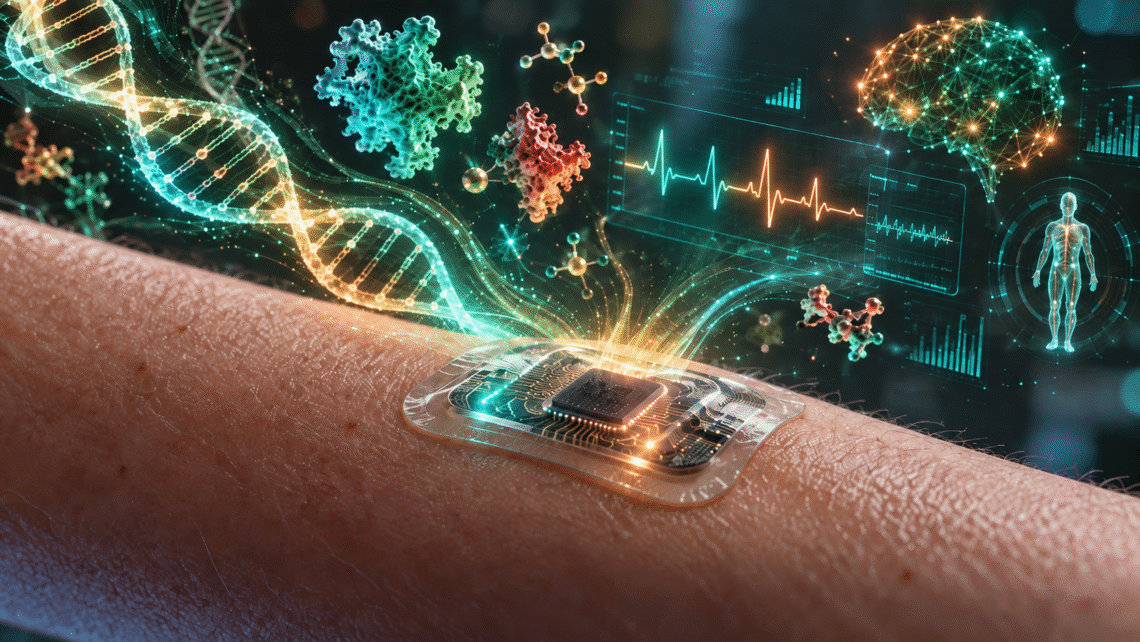
Some biosensors are wearable, like patches, smartwatches, or skin sensors. Others could be implanted inside the body. Some could be used in small test strips, paper-based devices, or lab-on-a-chip systems. The main goal is the same: detect biological signals faster, easier, and sometimes continuously.
Imagine a patch on your skin that can analyze your sweat.
It might detect changes in hydration, stress, or inflammation.
Or imagine a small sensor that can track heart-related biomarkers before a serious event happens.
Or a simple at-home test that can detect disease markers from saliva or breath.
That is why this field feels so interesting. It takes biology out of just the hospital lab and brings it closer to real life.
But collecting signals is only one part of the problem.
The body produces messy data.
A sensor might pick up changes, but those changes do not always mean something serious. Your heart rate could change because you are sick, but it could also change because you ran up the stairs, drank coffee, slept badly, or got stressed before a test.
So the question becomes: how do we know which patterns actually matter?
That is where AI comes in.
AI can help analyze biosensor data over time. Instead of looking at one number by itself, AI can compare patterns. It can look for changes that are unusual for one specific person. It can help separate random noise from warning signs.
That part matters because health is personal.
A “normal” heart rate for one person may not be normal for another. A small change in one person’s data might mean nothing, while the same change in someone else could be important.
So smart biosensors are not just about measuring the body.
They are about learning what is normal for you.
This could be really important for early disease detection.
A lot of diseases are easier to treat when they are caught early. The problem is that early disease can be quiet. Cancer, heart disease, kidney disease, infections, and autoimmune conditions can sometimes begin changing the body before a person feels obvious symptoms.
If biosensors could detect those early signals, doctors might be able to respond sooner.
That does not mean a smartwatch is going to diagnose cancer tomorrow.
That would be unrealistic.
But it does mean healthcare could slowly move from waiting for symptoms to watching for patterns.
For example, AI-powered biosensors could help monitor patients with chronic diseases. Instead of checking in only during appointments, doctors could see how a patient’s body is changing over time. If something starts looking unusual, the system could alert the patient or doctor earlier.
This could also help with personalized medicine.
Instead of giving every patient the same monitoring plan, biosensors could help track how one patient is responding to one treatment. Is the medicine working? Are inflammation levels going down? Is the body reacting badly? Are there early signs that the dose needs to change?
That kind of feedback could make treatment feel less like guessing.
There is also a big future for biosensors outside hospitals.
Point-of-care testing means testing that happens close to the patient instead of sending everything to a big lab. This could be useful in schools, homes, clinics, rural areas, or places where medical resources are limited.
A fast, cheap biosensor could help detect infections, monitor diseases, or screen for health risks without needing a full hospital setup.
That could make healthcare more accessible.
But there are definitely problems too.
First, sensors have to be accurate. If a biosensor gives too many false alarms, people will stop trusting it. But if it misses something important, that could be dangerous.
Second, the data has to be protected. A biosensor could collect very personal information about someone’s body, habits, disease risks, and daily life. That is not data people want being shared without control.
Third, AI needs to be explainable enough for medicine. If an AI system says, “This pattern looks concerning,” doctors need to understand why. A black-box warning is not enough when real health decisions are involved.
There is also the problem of anxiety.
If people are constantly tracking every signal from their body, will that help them feel safer, or will it make them worry more? Not every small change is a disease. Sometimes the body is just being the body.
So smart biosensors have to be designed carefully.
The goal should not be to make people obsess over every number.
The goal should be to catch meaningful changes early and help doctors make better decisions.
That is what makes this field so powerful. Smart biosensors are not just gadgets. They are a new way of listening to the body.
For a long time, medicine has depended on symptoms, appointments, and occasional tests. But the future may look more continuous. More personalized. More predictive.
Instead of asking, “Are you sick yet?”
Medicine might start asking, “What is your body trying to tell us before you feel sick?”
That is the real promise of smart biosensors.
They could help turn invisible biological signals into early warnings.
And maybe one day, the first sign of disease will not be a symptom.
It will be a signal.